

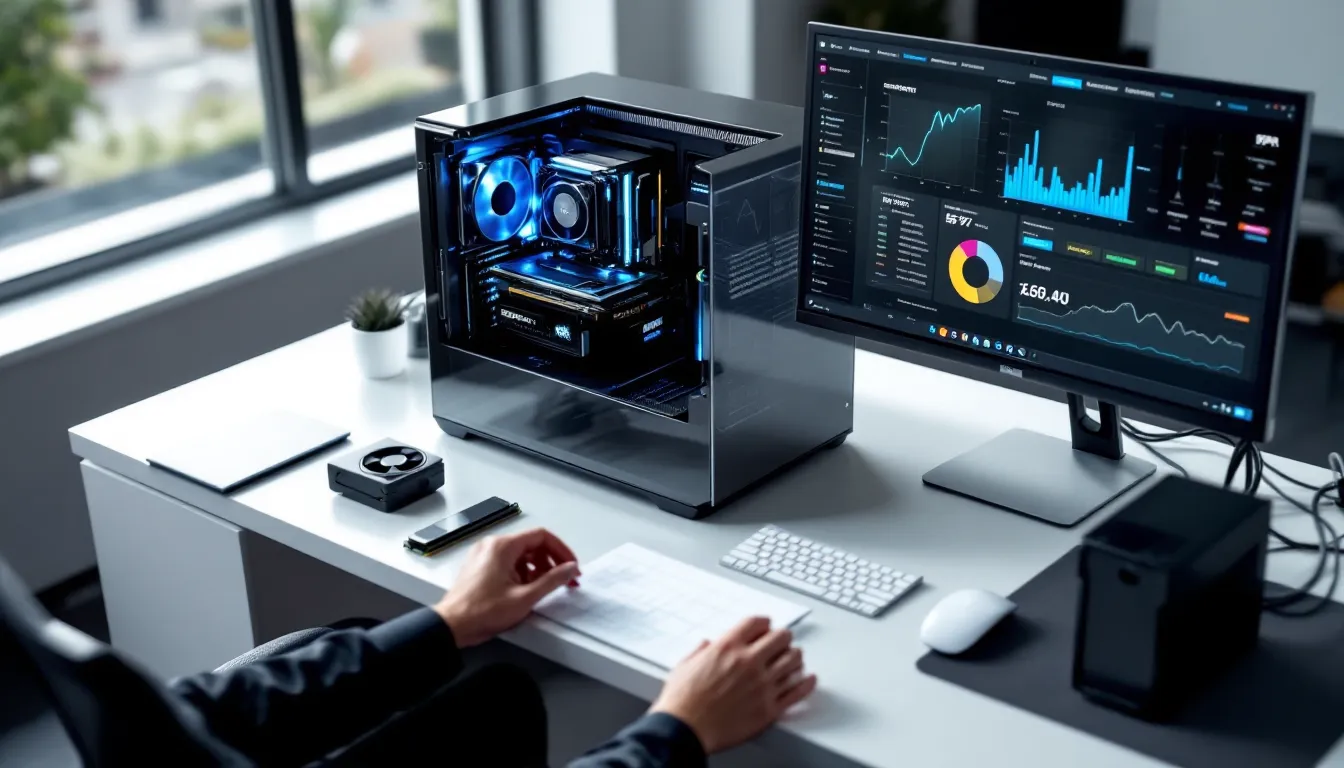
Gaming PC Upgrades: The Ultimate 2026 Guide to Maximizing Performance Without Breaking the Bank
Your gaming PC was a beast when you built it. Now it’s stuttering in the new Unreal Engine 5 titles, struggling to maintain 144fps, or taking forever to load into matches while your squad waits. You’ve got two options: drop $1,500+ on a completely new rig, or strategically upgrade the components that actually matter.
Most gamers waste money on the wrong upgrades. They’ll throw cash at RGB fans and flashy cases while their ancient HDD chokes every load screen, or they’ll buy a top-tier GPU only to find their CPU bottlenecking every frame. Smart upgrading isn’t about buying the newest, shiniest hardware, it’s about identifying what’s actually holding your system back and addressing it with precision.
This guide cuts through the marketing noise to show you exactly which upgrades deliver real performance gains in 2026, how to diagnose your system’s weak points, and how to build an upgrade path that matches your budget and gaming goals. Whether you’re chasing 1080p high-refresh esports performance or trying to max out 4K settings in the latest AAA releases, you’ll know exactly what to buy and when to buy it.
Key Takeaways
- Strategic gaming PC upgrades let you replace only underperforming components instead of buying a new system, potentially saving $800+ while delivering equivalent performance gains.
- Diagnose your bottleneck using Task Manager or MSI Afterburner before upgrading—a GPU maxed at 99% means your graphics card needs replacement, while a pegged CPU at 100% requires a processor upgrade instead.
- GPU upgrades deliver the biggest performance impact for most gamers, with RTX 4060/RX 7600 handling 1080p, RTX 4070 Super/RX 7800 XT dominating 1440p, and RTX 4080+ required for 4K gaming at ultra settings.
- 32GB of DDR5 RAM is the comfortable standard for 2026 gaming, eliminating stutters and supporting multitasking, though 16GB remains adequate for pure 1440p gaming without background applications.
- Upgrade storage from HDD to NVMe SSD for transformative results—Gen 3 NVMe ($35–45) handles gaming excellently, while Gen 4 ($150+) benefits DirectStorage-enabled titles with minimal load-time differences.
- Avoid common mistakes like pairing a high-end GPU with an undersized PSU, ignoring BIOS updates before CPU installation, or buying single-channel RAM, as these errors waste money and risk hardware damage.
Why Upgrading Your Gaming PC Beats Buying New
Building a PC from scratch in 2026 means paying current market prices for every single component, even the ones you don’t need to replace. Your case, PSU, storage drives, and often your RAM are perfectly functional, there’s zero reason to buy them again.
Upgrading strategically lets you keep what still works and only replace the components creating performance bottlenecks. A $400 GPU upgrade can deliver the same gaming performance boost as a $1,200 prebuilt system, especially if your existing CPU, RAM, and storage are still competitive.
The modularity of PC hardware is its biggest advantage over consoles. A mid-range gaming PC from 2022 might only need a GPU swap to match or exceed current-gen console performance. That same flexibility means you can spread upgrades over time, matching your budget to sales cycles and new hardware releases.
There’s also the environmental and economic angle. The semiconductor shortage taught everyone that GPU and CPU prices can spike without warning. If you’ve already got a solid foundation, a quality case, reliable PSU, and compatible motherboard, you’re insulated from having to buy everything at inflated prices during the next shortage or tariff wave.
How to Identify Your PC’s Performance Bottlenecks
Before spending a dime, you need to know what’s actually limiting your performance. Upgrading your GPU won’t help if your CPU is pinned at 100% usage while your graphics card idles at 40%.
Using Built-in Diagnostic Tools
Task Manager (Windows) is your first stop. Press Ctrl+Shift+Esc and switch to the Performance tab. Launch a demanding game and alt-tab to check usage percentages. If your GPU sits below 90% utilization while your CPU cores max out, you’ve got a CPU bottleneck. If your GPU is pegged at 99-100% while CPU usage stays moderate, your graphics card is the limiting factor.
MSI Afterburner with RivaTuner Statistics Server provides real-time overlays showing GPU/CPU usage, temperatures, and frame times during gameplay. Set it to display GPU usage, CPU usage (per core if possible), VRAM usage, and frame rate. Play your most demanding titles for 15-20 minutes and watch the numbers.
Windows Performance Monitor can track RAM usage and page file activity. If your system is constantly hitting 90%+ RAM usage and the page file is active during gaming, you need more memory or faster speeds.
Monitoring Performance During Gameplay
Synthetic benchmarks like 3DMark are useful for comparison, but real-world gaming tells the true story. Fire up the games you actually play, competitive shooters, open-world RPGs, whatever you spend your time on, and monitor performance under realistic conditions.
Pay attention to 1% low framerates, not just average FPS. If your game averages 90fps but the 1% lows drop to 35fps, you’re getting stutters that ruin the experience. This often points to RAM, storage, or CPU thread limitations rather than pure GPU power.
Check VRAM usage in GPU-heavy titles. If you’re constantly maxing out 8GB of VRAM at 1440p or 4K, texture streaming issues and stuttering will follow. Some recent GPU benchmark analyses show modern titles at ultra settings can push 10-12GB at 4K, making VRAM capacity a legitimate concern for high-resolution gamers.
Graphics Card Upgrades: The Biggest Bang for Your Buck
The GPU is the single most impactful upgrade for gaming performance, period. Unless you’re running a severely outdated CPU, a graphics card upgrade will deliver the most noticeable FPS gains and visual improvements.
Choosing the Right GPU for Your Resolution and Refresh Rate
Your monitor dictates your GPU requirements. A 1080p 60Hz display has completely different demands than a 1440p 240Hz esports monitor or a 4K 120Hz panel.
1080p gaming: Mid-range cards like the RTX 4060 or RX 7600 XT handle 1080p high-refresh gaming (144Hz+) in competitive titles and can push 60+ fps in AAA games at high settings. If you’re playing esports titles (Valorant, CS2, Apex Legends), even a previous-gen card like the RTX 3060 still crushes 240fps targets.
1440p gaming: This is the sweet spot for most enthusiasts in 2026. Cards like the RTX 4070 Super or RX 7800 XT deliver 100+ fps in most AAA titles at high/ultra settings. For competitive 1440p at 240Hz, you’re looking at RTX 4070 Ti or RX 7900 GRE territory to maintain those framerates in demanding titles.
4K gaming: You need serious horsepower. The RTX 4080 Super and RX 7900 XTX are the entry point for 4K 60fps+ gaming at ultra settings. The RTX 4090 remains the king for 4K high-refresh, but at a brutal price premium.
VRAM matters more as resolution increases. 8GB is tight for 1440p ultra and insufficient for 4K. Aim for 12GB minimum for 1440p longevity and 16GB+ for 4K.
When to Upgrade vs. Wait for Next Gen
This is always the toughest call. In mid-2026, we’re in an interesting spot. Nvidia’s RTX 50-series and AMD’s RDNA 4 launched earlier this year, which means current RTX 40-series and RX 7000-series cards are seeing price drops.
If your current GPU is 3+ generations old (GTX 1000-series, RX 500-series), upgrade now. You’re leaving massive performance on the table, and waiting another 12-18 months for the next generation means another year of compromised gaming.
If you’re running something like an RTX 3070 or RX 6700 XT, the calculus changes. These cards still handle 1440p gaming competently. Upgrading to current mid-range options might only net you 30-40% more performance, noticeable, but not transformative. In this case, waiting for next-gen mid-range cards or snagging a deal on current high-end models makes sense.
Monitor the used market too. Gamers upgrading to the latest gen often sell perfectly good RTX 4070s and RX 7800 XTs at steep discounts. Hardware communities at gaming discussion forums often share deals and performance comparisons that help time your purchase.
CPU Upgrades: When Your Processor Is Holding You Back
CPU upgrades are trickier than GPU swaps because they often require motherboard changes, which can cascade into RAM upgrades. But if your processor is bottlenecking your GPU or can’t maintain minimum framerates in CPU-intensive games, it’s unavoidable.
Socket Compatibility and Motherboard Limitations
Check your motherboard’s socket type and chipset before buying anything. Intel and AMD both change sockets every few generations, and even when sockets match, chipset limitations can prevent newer CPUs from working.
Intel: LGA 1700 (12th-14th gen) and the newer LGA 1851 (15th gen Arrow Lake) are the current platforms. If you’re on LGA 1200 (10th-11th gen) or older, you’ll need a new motherboard. The good news: B760 and B860 motherboards are affordable and support current-gen CPUs.
AMD: AM4 had an incredible run, supporting CPUs from 2017’s Ryzen 1000 through 2022’s Ryzen 5000. If you’re still on AM4, you can often upgrade to a Ryzen 5700X3D or 5800X3D for massive gaming gains without changing boards. AM5 (Ryzen 7000/8000/9000) requires DDR5 RAM and new motherboards, but it’s the platform with the longest future support.
BIOS updates matter. Some motherboards support newer CPUs only after a BIOS flash. Check your board manufacturer’s CPU support list before purchasing.
Best CPUs for Competitive Gaming in 2026
Competitive gaming prioritizes high framerates and low latency over visual fidelity. CPU performance directly impacts your 1% lows and frame pacing in esports titles.
Budget (under $200): The Ryzen 5 7600 and Intel Core i5-13400F offer excellent value. Six to ten cores, high clock speeds, and enough single-threaded performance to feed mid-range GPUs. These chips handle 240Hz competitive gaming without breaking a sweat.
Mid-range ($200-$400): The Ryzen 7 7800X3D is the sweet spot for gaming. Its 3D V-Cache tech delivers class-leading gaming performance, often matching or beating more expensive CPUs. Intel’s Core i5-14600K and newer i7-15700K offer strong alternatives with better productivity performance if you stream or edit.
High-end ($400+): For pure gaming, the Ryzen 7 9800X3D dominates, with independent hardware testing showing consistent leads in frame time consistency and 1% lows. Intel’s Core i9-14900K and i9-15900K compete when you need both gaming and heavy multi-threaded workloads.
For esports specifically, single-threaded performance and cache size matter more than core count. A 6-core CPU with high clock speeds and large cache often outperforms an 8-core chip with slower clocks in titles like Valorant, CS2, and Fortnite.
RAM Upgrades: Speed, Capacity, and What Actually Matters
RAM is the most misunderstood upgrade. Gamers either ignore it completely or obsess over speeds that deliver 2% gains. The truth is somewhere in the middle: capacity matters most, speed matters conditionally, and latency matters if you’re chasing the last 5% of performance.
How Much RAM Do Modern Games Really Need?
16GB is the baseline for 1080p/1440p gaming in 2026, but it’s getting tight. Games like Starfield, Cyberpunk 2077 with mods, and Flight Simulator 2024 can push 12-14GB during gameplay. Add Discord, browser tabs, and background apps, and you’re swapping to disk, which kills frame times.
32GB is the comfortable standard for gaming in 2026. It eliminates RAM as a bottleneck entirely, supports heavy multitasking (streaming, recording, multiple monitors), and leaves headroom for future titles. The price gap between 16GB and 32GB kits has narrowed significantly, often $30-50 difference, making 32GB the smart buy for any new build or upgrade.
64GB is overkill for pure gaming unless you’re running heavily modded games, doing content creation alongside gaming, or running virtual machines. Save the money for GPU or storage upgrades.
Dual-channel configuration is non-negotiable. Two 16GB sticks always outperform a single 32GB stick. The bandwidth difference impacts frame rates by 10-20% in CPU-limited scenarios.
DDR4 vs. DDR5: Is It Worth the Jump?
This depends entirely on your platform. If you’re upgrading within an existing DDR4 system, there’s no reason to jump to DDR5 unless you’re also replacing your motherboard and CPU.
DDR4 (3200-3600MHz CL16) still delivers excellent gaming performance in 2026. The difference between fast DDR4 and DDR5 in most games is 3-8%, which is noticeable in benchmarks but barely perceptible during actual gameplay. If you’re on AM4 (Ryzen 5000) or Intel 10th-11th gen, maximize your DDR4 kit, upgrade to 32GB at 3600MHz if you’re still at 16GB or slower speeds.
DDR5 (5600-6400MHz) is the standard for new builds on AM5 or Intel 12th gen and newer. Early DDR5 had inflated prices and minimal gains, but prices have normalized. In 2026, DDR5-6000 CL30 kits are affordable and deliver measurable benefits in CPU-bound scenarios, think 1080p competitive gaming at 300+ fps or games with heavy simulation (strategy games, MMOs, open-world titles with high NPC counts).
Ryzen 7000/9000 especially benefits from DDR5 due to Infinity Fabric scaling. AMD’s sweet spot is DDR5-6000 CL30, which balances speed, latency, and stability. Intel platforms are less sensitive to RAM speed but still benefit from faster kits.
If you’re building new, buy DDR5. If you’re upgrading an existing system, max out your DDR4 capacity before considering a platform change.
Storage Upgrades: From HDD to NVMe for Faster Load Times
Storage is the most underrated gaming upgrade. The difference between an HDD and a modern NVMe SSD isn’t just load times, it’s texture streaming, asset pop-in, and whether your game stutters when loading new zones.
Understanding SSD Generations and Performance Tiers
Not all SSDs are equal. The interface and controller determine real-world performance, not just the listed read/write speeds.
SATA SSDs: Still a huge upgrade over HDDs, with read speeds around 500-550 MB/s. If you’re stuck with older motherboards that lack M.2 slots, a SATA SSD is your best option. But if you have M.2 slots, skip SATA entirely.
PCIe Gen 3 NVMe: Read speeds of 2000-3500 MB/s. These are the value kings in 2026, cheap, widely compatible, and fast enough for gaming. Examples include the WD Blue SN570 and Crucial P3. For pure gaming, Gen 3 drives deliver 95% of the experience of Gen 4 at significantly lower prices.
PCIe Gen 4 NVMe: Read speeds of 5000-7400 MB/s. Drives like the Samsung 990 Pro, WD Black SN850X, and Crucial P5 Plus offer bleeding-edge performance. The difference in game load times compared to Gen 3 is often 1-2 seconds, but they excel in DirectStorage-enabled titles and content creation workflows.
PCIe Gen 5 NVMe: Read speeds exceeding 10,000 MB/s. These are enthusiast-tier drives that are overkill for gaming in 2026. Titles haven’t caught up to fully use Gen 4, let alone Gen 5. Save your money unless you’re working with massive 8K video files.
Capacity recommendations: 500GB for boot drive + a few games, 1TB as the sweet spot for most gamers (OS + 10-15 AAA titles), 2TB if you play Call of Duty and other 200GB+ install-size monsters or want your entire library installed.
How Storage Affects Gaming Beyond Load Screens
Load times are obvious, but modern games use storage bandwidth during gameplay. Open-world titles stream textures and assets as you move through the environment. An HDD can’t keep up, resulting in low-res textures popping in late or stuttering when entering new areas.
DirectStorage (Windows 11) and similar APIs allow games to load assets directly to VRAM without burdening the CPU. Titles like Forspoken and Ratchet & Clank: Rift Apart use this to eliminate traditional load screens and enable rapid scene transitions. A fast NVMe drive is required to take advantage.
Shader compilation is another hidden factor. Games that compile shaders at launch or during gameplay (looking at you, Unreal Engine 5 titles) benefit significantly from NVMe speeds. The difference between a Gen 3 and Gen 4 drive can shave 30-40 seconds off initial shader builds.
For competitive multiplayer, faster storage means faster match loads, which matters in games with limited pre-round time. Being first into the server to claim your agent or secure positioning is a real advantage in titles like Valorant and Rainbow Six Siege.
Power Supply and Cooling: The Often-Overlooked Essentials
PSU and cooling aren’t exciting upgrades, but they’re foundational. A cheap PSU can fry your components during a power surge, and inadequate cooling throttles performance no matter how expensive your CPU and GPU are.
Calculating Your PSU Requirements
Don’t just eyeball it, calculate your actual power draw. Modern GPUs spike well above their TDP ratings under load, and PSU efficiency curves mean you don’t want to run at 95% capacity constantly.
Use an online PSU calculator or follow this rough formula:
- Mid-range build (RTX 4060/RX 7600 + Ryzen 5/i5): 550-650W PSU
- High-end build (RTX 4070 Ti/RX 7900 XT + Ryzen 7/i7): 750-850W PSU
- Enthusiast build (RTX 4080/4090 + Ryzen 9/i9): 850-1000W PSU
The RTX 4090 is infamous for power spikes hitting 500W+ momentarily. Pairing it with an undersized PSU causes crashes or shutdowns during intense scenes. Tests from leading hardware reviewers confirmed that transient spikes can exceed listed TDP by 50-100W.
Efficiency ratings (80 Plus Bronze/Gold/Platinum/Titanium) matter for long-term costs and heat output. An 80 Plus Gold unit wastes less power as heat and saves money on electricity over its lifespan. Modular cables aren’t necessary but significantly improve cable management and airflow.
Brands matter. Stick with proven names: Corsair RMx/RM, Seasonic Focus/Prime, EVGA SuperNOVA (if still available), and MSI MPG. Avoid no-name Amazon specials, PSU failures can take other components with them.
When to Upgrade Your Cooling Solution
Stock coolers on most CPUs are adequate for base operation but struggle under sustained loads or in warmer climates. If your CPU is hitting 85°C+ during gaming or you hear the fan screaming at 100%, it’s time to upgrade.
Air cooling: Tower coolers like the Thermalright Peerless Assassin 120 SE, DeepCool AK620, or Noctua NH-D15 offer incredible value. They cool mid-range and even high-end CPUs quietly and efficiently for $30-$100. Air coolers are reliable, require zero maintenance, and can’t leak.
AIO liquid coolers: 240mm and 280mm AIOs work well for mid-to-high-end CPUs, while 360mm units handle flagship chips under heavy overclocks. Brands like Arctic Liquid Freezer III, Corsair iCUE Link, and NZXT Kraken dominate the space. AIOs look cleaner and can fit in smaller cases, but they cost more and have a lifespan of 5-7 years before pump failure becomes likely.
GPU cooling: Most GPUs have adequate factory cooling, but if you’re running a high-end card in a cramped case, consider adding case fans or upgrading to a model with better cooler design. Undervolting can also drop temperatures by 5-10°C without sacrificing performance, free thermal headroom.
Case airflow often bottlenecks cooling more than the coolers themselves. Ensure positive or neutral pressure with at least two intake fans and one exhaust. Dust filters are essential if you’re running positive pressure.
Budget-Friendly Upgrade Paths for Different Performance Goals
Not everyone can drop $800 on a GPU. Strategic upgrades let you hit specific performance targets without nuking your savings.
1080p High-Refresh Gaming on a Budget
Goal: 144fps+ in competitive titles, 60fps+ in AAA games at high settings.
Priority 1: GPU – An RTX 4060 ($300) or RX 7600 ($270) delivers solid 1080p high-refresh performance. Used options like the RTX 3060 Ti ($200-250 used) punch above their price class if you can find one in good condition.
Priority 2: CPU – If you’re on anything older than a Ryzen 3000 or Intel 9th gen, upgrade to a Ryzen 5 5600 ($130 if on AM4) or i5-12400F ($150) for massive gains in frame pacing and 1% lows.
Priority 3: RAM – Bump to 16GB minimum (3200MHz DDR4). If you’re already at 16GB, skip this and put the money toward the GPU.
Priority 4: SSD – If you’re still booting from an HDD, a 500GB Gen 3 NVMe drive ($35-45) is transformative. Install your OS and primary games here.
Total cost: $400-600 for GPU + CPU, or $250-350 for GPU-only upgrade if your CPU is still competitive.
4K and Ultra Settings: Premium Upgrade Strategy
Goal: 4K 60fps+ at ultra settings, or 1440p 165fps+ in AAA titles.
Priority 1: GPU – You need an RTX 4080 Super ($1000) or RX 7900 XTX ($900) minimum. The 4090 is the king but at $1600+, it’s diminishing returns unless you’re also doing AI workloads or 4K ultra-high-refresh gaming.
Priority 2: CPU – Pair with a Ryzen 7 7800X3D ($390) or i7-14700K ($380). At 4K, you’re usually GPU-bound, but a strong CPU prevents bottlenecks in CPU-heavy titles like Baldur’s Gate 3 and simulation games.
Priority 3: RAM – 32GB DDR5-6000 is the target. Budget $120-150 for a quality kit. This headroom matters when you’re pushing max settings and high resolutions.
Priority 4: PSU – An 850W Gold-rated unit is mandatory for RTX 4080-class cards. Budget $120-150 for a quality modular PSU like the Corsair RM850x.
Priority 5: Cooling – A 280mm AIO or high-end tower cooler keeps your CPU from throttling during long sessions. Budget $80-120.
Total cost: $1600-$2200 depending on whether you need motherboard, RAM, and PSU upgrades alongside the CPU and GPU.
The 4K upgrade path is expensive, but you’re building a system that’ll stay relevant for 4-5 years at high settings. Spread the purchases over a few months if needed, upgrade GPU first, then CPU/platform, then peripherals and cooling.
Common Upgrade Mistakes to Avoid
Gamers blow money on the wrong upgrades constantly. Here’s what not to do.
Upgrading the GPU without checking PSU capacity. The number of posts in hardware forums about new GPUs causing shutdowns is staggering. Calculate your power needs before buying. A $50 PSU upgrade now beats replacing fried components later.
Buying a CPU without checking motherboard compatibility. Socket and chipset matter. A 14th-gen Intel chip won’t work in your Z490 board, and a Ryzen 9000 needs AM5, not AM4. Always verify compatibility on the motherboard manufacturer’s site before purchasing.
Ignoring RAM compatibility and speed limits. Your motherboard has maximum supported RAM speeds. Buying DDR4-4000 for a board that caps at 3200MHz wastes money. Check your board’s QVL (Qualified Vendor List) for tested RAM kits to avoid stability issues.
Upgrading to the latest gen when last-gen offers better value. New doesn’t always mean better bang-for-buck. An RTX 4070 Super at $600 often outperforms an RTX 4060 Ti at $450 even though being “older” in the product stack. Research benchmarks, not just release dates.
Cheaping out on the PSU. A no-name 750W PSU for $40 is a disaster waiting to happen. PSU failures can take your GPU, motherboard, and storage with them. Spend the extra $30 for a reputable brand with proper protections (OVP, UVP, OCP, OTP).
Over-investing in storage speed for gaming. A Gen 5 NVMe drive costs 2x more than Gen 4 for gains you won’t notice in 99% of games. Put that money toward GPU, CPU, or more storage capacity instead.
Forgetting to update BIOS before installing a new CPU. Some motherboards need a BIOS flash to support newer CPUs, even if the socket matches. If you install the CPU first, the system won’t POST. Flash BIOS with your old CPU installed, then swap.
Buying single-channel RAM or mismatched sticks. Always run dual-channel. One 16GB stick performs significantly worse than two 8GB sticks. If adding RAM to an existing kit, match speed, timings, and ideally brand/model to avoid instability.
Conclusion
Upgrading a gaming PC isn’t about throwing money at the newest hardware, it’s about understanding your system’s limitations and addressing them strategically. A $300 GPU upgrade can feel like an entirely new machine if your graphics card was the bottleneck, while that same $300 wasted on unnecessary RGB and aesthetics delivers zero FPS.
Start with diagnostics. Know whether your CPU, GPU, RAM, or storage is holding you back before you spend a dollar. Match your upgrades to your actual gaming habits and monitor specs, there’s no point in 4K-capable hardware if you’re gaming on a 1080p 144Hz display.
Prioritize GPU for raw performance, CPU for competitive high-refresh gaming, RAM for eliminating stutters, and storage for load times and asset streaming. Don’t neglect your PSU and cooling, they’re the foundation that keeps everything stable and performing at peak.
In 2026, the upgrade landscape is better than ever. Prices have stabilized, both AMD and Nvidia offer competitive options across price tiers, and platforms like AM5 promise years of future CPU support. Whether you’re on a $300 budget or planning a $2000 overhaul, there’s a clear path to better performance without buying an entirely new system.